Welcome to VMR MINING

A mining news blog providing industry professionals with real-time news and analysis, The blog covers regional news from different Mining regions in India and updates it’s readers with issues affecting Indian mining industry, created by Virginia Mining Resources

Showing posts with label Japan. Show all posts
The U.S. is expected to retain its status as the world's largest economy for a few years longer than analysts previously anticipated, thanks in large part to China's recent financial slowdown, according to a recent study from the U.K.- based Centre for Economics and Business Research.

But over the course of the next 16 years, the global economic landscape is expected to shift seismically from where it now stands. Though the U.S.
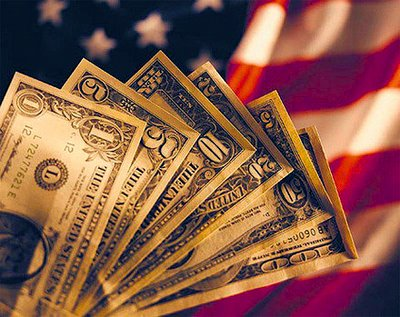
is still expected to hold a spot among the exclusive G-8 collection featuring some of the world's largest economies by the year 2031, a handful of other current mem-bers are likely to be less fortunate.

In 2031, China will be the largest economy in the world with a gross domestic product valued at $35.26 trillion, according to the CEBR. The U.S. will play second fiddle to the Asian behemoth, with GDP clocking in at $33.66 trillion.

The two world powers are expected to swap places in 2029, which gives the U.S. a little more time on top than the economic consultancy previously projected. Last year, the CEBR predicted the switch would take place in 2025. It attributed "slower Chinese GDP growth and a weaker currency" to the timing adjustment.

By some measures, China is already considered the world's largest economy. According to a report released last year by the International Monetary Fund that compared international economies by adjusting for exchange rates and purchasing power, China's economy had already surpassed America's as the world's largest.

But most analysts don't consider that purchasing power metric to be a primary measuring stick. The U.S. is still generally hailed as the world's largest economy and is likely to retain that title for at least the next decade.

"No doubt, [China's] GDP is worse than that 6 or 7 percent that they report," says Mr. John Canally, a senior vice president and chief economic strategist at LPL Financial. "No doubt they'll lower that target next year, but there's also no doubt that they'll pull out all the stops to make sure that the Chinese economy at least stabilizes next year."

China and the U.S. are hardly the only nations whose economic standing is expected to shift by 2031, according to the CEBR. France and Italy are expected to lose their places among the eight largest economies in the world, to be replaced by South Korea and Brazil. And that could mean major shake-ups in trade groups and economic organizations are right around the corner.

"Some of the weaker European economies like France and Italy are slipping way down the table. They face exclusion from bodies like the G-8 and pos-sibly eventually the G-20 as their economies persis-tently underperform," a statement accompanying the report said. "International bodies are likely to have to change their membership to reflect the changing balance of economic power."

The internationally influential G-8 group of major world economies (which has consisted of the U.S., Germany, Russia, France, Italy, Japan, the U.K. and Canada, though Russia was suspended from inclusion last year over its actions in Crimea) already isn't or-ganized based solely on GDP value. China and India, for instance, are absent from the group and countries like Canada and Russia – neither of which cracks the world's top eight in terms of GDP – are or were previ-ously included.

So it is likely that at least some adjustment will take place in the G-8 and organizations similar to it going forward. Adding weight to that projection, the CEBR said the world's slowest-growing region over the next decade and a half will be Western Europe, with its share of the global economy falling by more than 40 percent by 2031.

The 19-country eurozone's collective GDP has expanded by an average of only 0.2 percent per quarter since 2010. For comparison's sake, the U.S. has maintained an average of more than 2.1 percent over the same window.

"Although France continues militarily to punch above its weight, replacing the U.K. as the U.S.'s leading military partner in the Middle East, economically the picture is dire," the report said. "France is forecast to slip from being the fifth-largest world economy in 2013 to the ninth-largest by 2031, leading it no longer to qualify on economic grounds for member-ship of the G-8 largest economies."

The United Arab Emirates, meanwhile, is expected to crack the Top 30 largest economies for the first time by 2031, while Asian nations like Malaysia and the Philippines also are projected to make their way onto the list. Indonesia is expected to jump from the 17th slot to the 11th.

But perhaps the biggest mover is India, an economy that ranked as only the ninth largest in 2014. The country will move up to No. 3 by 2031, according to the CEBR, and has already eclipsed China in terms of annual growth. India is currently the sole bright spot among the emerging market growth engines known as the BRICS nations (which also include Brazil, Russia, China and South Africa), and the World Bank projects the country's expected 7.5 percent GDP growth in 2015 (which will inflate up to 8 percent by 2017) will outpace most other major world economies.

"The world's most populous nation has made a start in 2015 in catching up with China, with faster economic growth than China for the first time in years," the CEBR report said. "But there is still a long way to go, and India is only likely to overtake China at some point in the second half of the 21st century."

Indeed, it's worth noting that India's GDP is expected to be valued at $10.63 trillion in 2031. That's still smaller than the current sizes of both the Chinese and American economies, and it will be less than a third the size of either in 2031. So although the U.S. is expected to fall to No. 2, it's unlikely any nation other than China and maybe India will catch the country in the foreseeable future.
And considering the populations of both China and And considering the populations of both China and India dwarf that of the U.S., that's not entirely surprising.

"The United States remains the most successful of the world's older economies and the world's techno-logical leader," the report said. "Indeed, as software becomes the world's key industry, the U.S.'s position as a technology leader is reinforced."

(Source – U.S. News, 28-December-2015)
In August, a Japanese utility company restarted the Sendai nuclear power plant, sparking controversy and protests. Like the rest of the country’s nuclear power generators, Sendai was shut down following the 2011 Fukushima disaster, in which a powerful earthquake and tsunami caused three reactors to melt down. Sendai is the first and so far only nuclear plant to reopen, and with memory of the catastrophe still fresh, the public outcry is hardly surprising. Applications by other plants to relaunch are also facing legal challenges.

Restarting Japan’s nuclear power plants is, however, the right decision, provided they can pass strict new safety checks instituted since Fukushima. The reason is simple: While nuclear power comes with risks, the primary alternative comes with bigger ones.

Turning off nuclear power requires either turning on another power source, or using less electricity. Japan has done both. Its total energy consumption is down 10 percent since 2010 due to the nuclear phase-out, but use of natural gas, a source of greenhouse gas emissions, is up 19 percent, and use of coal, which is even more harmful to the environment, is up 2 percent. (The data is available here.) Japan is now building 45 new coal power plants, but if it turned its nuclear power plants back on (except of course for the damaged Fukushima facilities), it could cut coal consumption in half. And coal poses more health and climate change dangers than nuclear power.

The primary harm caused by nuclear accidents is increased cancer risk from released radiation. But the radiation levels from Fukushima are so low that the cancer increase will be barely noticeable, and may not happen at all. To be sure, the radiation exposure would have been worse if the prevailing winds did not blow most of the radiation out to the Pacific. But as with the Chernobyl catastrophe in 1986, the Fukushima disaster caused more harm from overreaction to the radiation than from radiation itself. That’s partly because excessive evacuations can cause more deaths than they prevent. The anti-radiation stigma also levied a psychological toll, with some healthy people committing suicide. In Chernobyl, as many as 100,000 unnecessary abortions may have been performed due to fears of radiation’s impact.

Another nuclear power plant accident in the near future is, moreover, extremely unlikely. It is normal to pay attention to disasters that are fresh in our memory and overestimate the risk of another; psychologists call this the recency effect. But nuclear plant accidents do not come in bunches. According to the International Atomic Energy Agency (IAEA), the Fukushima accident is only the second Level 7 major accident in nuclear power history, the first being the Chernobyl disaster 29 years ago.

If anything, we should expect the probability of another accident in Japan to be smaller now because so many people are paying attention to the plants and the institutions overseeing them. Meanwhile, coal plants also damage human health,through asthma, bronchitis, cancer, and other illnesses. The difference is that nuclear plants only harm health following rare accidents, whereas working coal plants do so all the time. So by switching from nuclear to coal, Japan is rejecting a small chance of increased cancer in favor of a guaranteed increase in cancer and other maladies. In fact, one study found that coal causes 387 times more deaths per unit of energy than nuclear power. Since coal is also more expensive for Japan (as even critics of the nuclear restart have pointed out), restarting the nuclear plants appears to be very much in the country’s national interest.

It is also in the world’s interest. Of all major energy sources, coal is the worst emitter of greenhouse gases, warming the planet more per unit of electricity than anything else. According to the Intergovernmental Panel on Climate Change, nuclear power plants emit about one-tenth to one-twentieth of the greenhouse gases that coal plants do, with emissions coming mainly from power plant construction and uranium mining. And climate change, which affects the entire planet for millennia, is a bigger danger than nuclear plant accidents, which affect small regions for a few years.

True, nuclear waste can also survive for millennia, but carbon dioxide emissions are worse for both hu-manity and nature. They spread worldwide, whereas nuclear waste is confined to a fixed location. (A regu-latory double-standard currently exists across the world, in which the nuclear sector is required to sequester its waste for the long term, but the fossil fuel sector is not.) At worst, nuclear waste can render small regions uninhabitable, though it’s worth noting that the Chernobyl area now has flourishing wildlife. Carbon dioxide emissions, however, will ruin far more land via sea-level rise and other changes to the landscape such as desertification, invasive species, and ecological regime shifts. At worst, carbon dioxide emissions could render large portions of Earth’s surface uninhabitable for mammals: When temperature and humidity are so high that we cannot perspire to regulate our body temperatures, we overheat and die.

No accounting of nuclear power risks would be complete without considering the possibility that it can contribute to the spread of nuclear weapons. Since nuclear power can facilitate development of the materials and technology required to make such weapons, ordinarily one might expect the risk to increase with more power plants. However, due to a unique mix of technological and political factors, today, more nuclear power in Japan would actually lower the risk of nuclear weapons proliferation.
The reason for Japan’s unusual situation comes from the fact that it is the only non-nuclear-armed state that reprocesses plutonium. The intent is to plow the material back into nuclear reactors to make more electricity, but Japan’s resulting plutonium stockpile is now big enough to produce thousands of nuclear weapons. In 2016, the country plans to open the much-delayed Rokkasho Reprocessing Plant, which, in the absence of operational nuclear plants to consume the resulting plutonium, would increase the stockpile even further.

Japan currently has 47 metric tons of separated plutonium, 11 at home and 36 in France and the United Kingdom. If all of its nuclear power plants capable of consuming plutonium were restarted, and the Ohma plant, now under construction, were completed, Japan could consume about 4 metric tons per year—in principal drawing down its domestic supply within three years and its international supply in nine. However, if Rokkasho opens it will produce about 4.5 metric tons per year, exceeding Japan’s ability to use up its supply. And, as James Acton of the Carnegie Endowment for International Peace writes in a recent report, Rokkasho is likely to open because the surrounding area counts on it for economic development, whereas nuclear power plant reopenings, which are more controversial in their local communities, are less of a sure thing.

There is no reason to believe that Japan plans to use its extra plutonium for weapons, and the country cooperates closely with the International Atomic Energy Agency to ensure compliance with safeguards. Still, choosing to let the stockpile grow further could worsen regional tensions, especially with China, which may question Japan’s intentions. The reprocessed plutonium buildup also sets a harmful international precedent, for example with respect to Iran’s nuclear program. If Japan restarted more nuclear plants and decreased its plutonium stockpile, it could help ease concerns about its intentions and set a good example, helping to decrease global nuclear weapons risk.

Of course, nuclear and coal are not the only electricity options. Other fossil fuels pose the same global warming and health problems as coal, albeit to a somewhat smaller degree. Renewable do not, but Japan has been slow to adopt them. Ultimately a full transition to renewable may be a good idea, but that will take time, and nuclear power plants can be restarted now. Bringing them back online would be the best current energy option for Japan and for the world.

(Source – Bulletin of Atomic Scientist)

You can also follow us, for more mining & metal or energy update on Twitter